
WHAT WE DO
How we learn, listen, and put empathy into practice.
DIALOGUE
Informed discussion
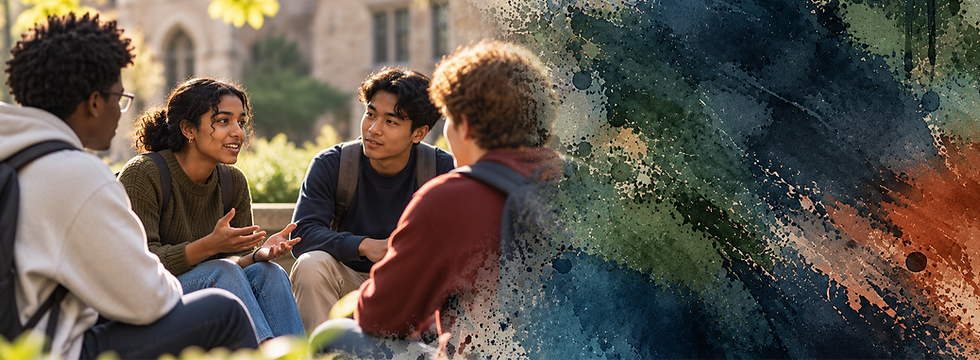
Throughout the school year, we discuss topics including war, free speech, extremism, sexism, racism, bias, gun control, equity, and access. Exploring these difficult and controversial topics takes preparation. Members read articles, listen to podcasts, and work through other materials that, taken together, present multiple perspectives, so that our conversations rest on careful research and a deep understanding of the issues at hand rather than on assumptions.

PRACTICE
Mediation and conflict-resolution training
Members strengthen their communication skills and learn practical strategies for navigating disagreement and finding common ground without needing to reach consensus.
Through role-playing exercises and facilitated discussions, they practice understanding issues from perspectives different from their own. This builds both their capacity for empathy and their confidence to engage in complex, nuanced conversations.
CONNECT
Dialogue across communities
One of our most meaningful initiatives has been creating spaces for Jewish, Muslim, and other students to share their perspectives on the Gaza-Israel war.
On one occasion, we hosted conflict-resolution expert Marianne Perez-Fransius, who moderated discussions among Columbia High School students and other Jewish and Muslim young people in the United States and the Middle East.
Those conversations showed us that even the most emotionally charged subjects can be approached with empathy, honesty, and mutual respect.


SERVE
Service together
Our commitment to empathy extends beyond dialogue. Members organize food and clothing drives and take part in service projects at local shelters that support people experiencing homelessness. Like our conversations, this work is grounded in respect for the dignity of every person.
